We offer refined, unrefined, deodorized, and winterized sunflower oil — suitable for retail, HoReCa, and industrial use. Bottling and bulk options are available.
Sunflower Oil for Export to the EU: Requirements, Standards, and Selection Criteria for Ukrainian Producers
The European Union is one of the most attractive yet most demanding markets for Ukrainian agricultural products, particularly sunflower oil. Thanks to high quality and significant production volumes, Ukrainian sunflower oil has every opportunity to secure a strong position on European shelves. However, successfully entering this market requires not only a quality product but also a deep understanding of and strict adherence to the EU’s stringent requirements and standards.
In this article, we will examine in detail how to select and prepare high-quality sunflower oil for export to the EU, which key quality indicators are critical, which European regulations must be taken into account, and which certification and documentation steps are mandatory. Our goal is to provide Ukrainian producers with a comprehensive guide that helps avoid common mistakes and ensures successful export. Compliance with these requirements is not just a formality — it is the key to consumer trust, stable trade relations, and a strong reputation for Ukrainian products on the international stage.
Why Does the European Union Set High Requirements for Imported Oil?
The EU’s high requirements for imported food products, including sunflower oil, are driven by several fundamental reasons:
- Consumer safety and health protection. This is the top priority. The EU aims to ensure that all food products entering its market are safe for consumption and do not pose any threat to public health. This includes controlling the content of contaminants, pesticides, mycotoxins, and other harmful components.
- Single market and fair competition. Setting common standards for all importers ensures a level playing field and prevents unfair practices where some producers may lower quality for price advantage. It also simplifies internal EU trade, as products meeting the standards of one member state can be freely sold in others.
- Reputation of Ukrainian products. Compliance with high European standards not only allows access to the EU market but also significantly enhances the global reputation of Ukrainian agricultural products. This opens doors to new markets and strengthens Ukraine’s position as a reliable supplier of quality food products.
Key Quality Indicators for Sunflower Oil Export to the EU
Compliance with specific quality indicators is critical for sunflower oil intended for export to the EU. These indicators are divided into physico-chemical properties and safety indicators.
Physico-Chemical Indicators:
- Acid Value: Indicates the content of free fatty acids in the oil, which are formed as a result of fat hydrolysis. A high acid value indicates poor raw material quality or improper storage and production conditions. For refined sunflower oil, EU requirements generally set very low limits, typically no higher than 0.6 mg KOH/g.
- Peroxide Value: Reflects the degree of oxidation of the oil, which affects its taste, odor, and shelf life. A high peroxide value indicates the beginning of rancidity. EU norms for sunflower oil are strict, usually up to 10 mmol of active oxygen/kg for refined oil.
- Moisture and Volatile Matter: Excess moisture promotes microbial growth and accelerates hydrolysis. This indicator must be minimal.
- Color Number: Describes the color of the oil, which is an important organoleptic characteristic.
- Iodine Value (for identification): Used to determine the degree of unsaturation of fatty acids in the oil, which helps identify its type and purity.
Safety Indicators:
Safety indicators are among the strictest and most important for EU export, as they directly affect consumer health.
- Pesticide Residues: Maximum Residue Levels (MRLs) are regulated by Regulation (EC) No 396/2005. This means that the content of any pesticides in sunflower oil must not exceed established limits. Careful control of raw materials and finished products is required.
- Heavy Metals (lead, cadmium, mercury, arsenic): These toxic elements can accumulate in the body. Their content in food products is strictly regulated by Regulation (EC) No 1881/2006.
- Mycotoxins (including aflatoxins): Aflatoxins are toxic substances produced by certain molds. They may be present in sunflower seeds if stored improperly. The EU sets very low permissible aflatoxin levels.
- Dioxins and PCBs (polychlorinated biphenyls): Persistent organic pollutants that can enter the food chain from the environment. Their content is also strictly controlled by Regulation (EC) No 1881/2006.
- Genetically Modified Organisms (GMOs): The EU has strict GMO requirements, including mandatory labeling for products containing GMOs above the set limit (usually 0.9%). It is important to ensure traceability of raw materials and avoid cross-contamination.
European Standards and Regulations for Sunflower Oil
To successfully export sunflower oil to the EU, Ukrainian producers must comply with a number of key EU regulations and international standards.
Main EU Regulations:
- Regulation (EC) No 178/2002 (General Food Law): The foundation of EU food law. Establishes general principles and requirements for food and feed safety, including “farm-to-fork” traceability and operator responsibility.
- Regulation (EC) No 396/2005 (On maximum residue levels of pesticides): Defines maximum permitted levels of pesticide residues in food and feed. Regularly updated.
- Regulation (EC) No 1881/2006 (On maximum levels for certain contaminants in food): Sets maximum permissible levels for heavy metals, mycotoxins, dioxins, PCBs, and other contaminants that may be present in oil.
- Regulation (EU) No 1169/2011 (On the provision of food information to consumers – labeling): Key regulation for proper product labeling. Requires clear and legible listing of ingredients, nutrients, allergens, storage conditions, country of origin, and other important information.
International Standards (as supplementary):
Although international standards such as ISO or Codex Alimentarius are not mandatory in the EU, they often serve as benchmarks and complement EU legislation, especially for exports beyond the EU.
- ISO (International Organization for Standardization): Certain ISO standards may relate to testing methods or quality management systems, useful for demonstrating compliance.
- Codex Alimentarius: A collection of internationally recognized standards, guidelines, and codes of practice for food products. Serves as a reference for many countries and can influence the harmonization of national and regional requirements.
Certification and Documentation for Export
The certification process and gathering of required documentation is one of the most complex stages of sunflower oil export to the EU. It demands attention to detail and cooperation with accredited bodies.
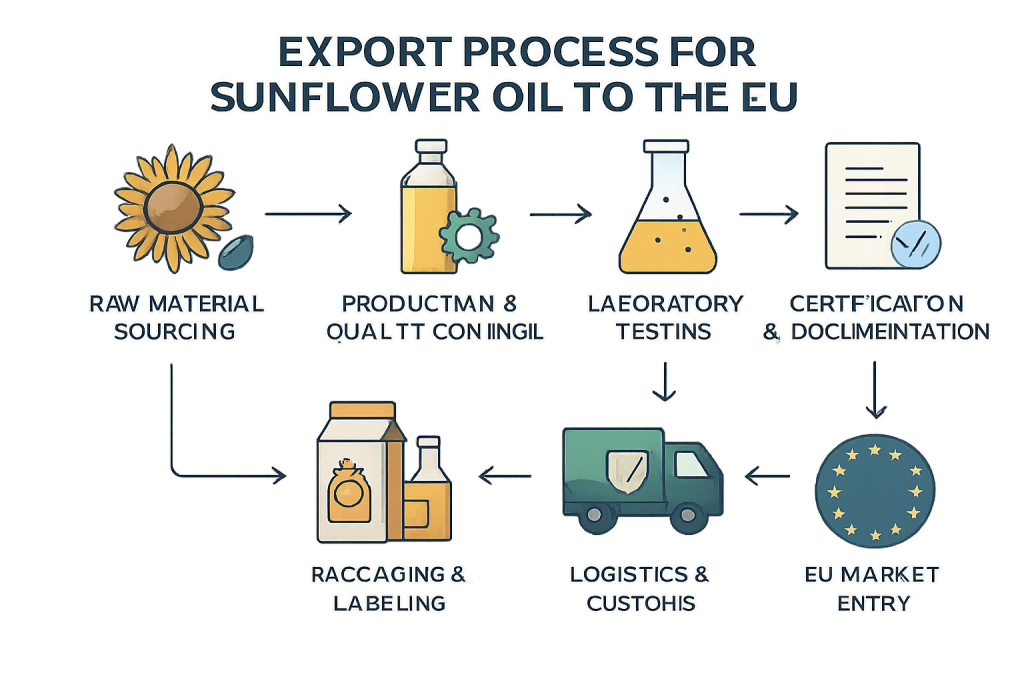
Required Certificates:
- Certificate of Origin (EUR.1 – if applicable under free trade agreement): Allows EU importers to benefit from preferential or zero tariffs under the EU–Ukraine Association Agreement. Confirms the product’s Ukrainian origin.
- Phytosanitary Certificate (if required): Needed if the sunflower oil contains plant components or is classified as potentially carrying plant pests. Generally not required for refined oil but may be needed for crude oil or seeds.
- Quality Certificate / Test Reports: Critical documents proving compliance with all physico-chemical and safety parameters set by the EU. Reports must be issued by an accredited laboratory.
- Declaration of Conformity: Issued by the manufacturer, confirming that the product complies with all applicable EU regulations and directives.
- Food Safety Management System Certificates: The EU values producers with internationally recognized food safety management systems in place, such as:
- HACCP (Hazard Analysis and Critical Control Points): A systematic approach to identifying, assessing, and controlling hazards affecting food safety. Mandatory in the EU.
- FSSC 22000: A global certification scheme for food safety management systems, including ISO 22000 and additional requirements.
- ISO 22000: An international standard for food safety management systems covering the entire supply chain.
Laboratory Testing:
Laboratory testing is the cornerstone of the entire process of confirming product quality and safety.
- Selecting an Accredited Laboratory: It is crucial to work with laboratories holding international accreditation (e.g., ISO/IEC 17025). This guarantees the credibility and international recognition of test results. The Blagolia laboratory provides a full range of tests required for sunflower oil export to the EU.
- Types of Tests to Conduct: Depending on the type of oil (refined/unrefined), target markets, and buyer requirements, the test list may vary. The basic package includes: acid value, peroxide value, moisture, heavy metals, pesticides, mycotoxins (aflatoxins), dioxins, and PCBs. For high-oleic oil – fatty acid composition analysis.
- Interpretation of Results: It is important not only to obtain results but also to interpret them correctly according to current EU standards. Experts can assist with this process.
Download our complete checklist for verifying sunflower oil compliance with EU standards and simplify your export process! [Download Checklist]
How to Choose Quality Sunflower Oil for Export: Practical Steps
Ensuring sunflower oil quality for EU export starts long before shipment and covers all stages of production.
Quality Control Stages in Production:
- Raw Material Control (sunflower seeds): Final product quality depends directly on seed quality. Incoming seed should be checked for moisture, cleanliness, damage, as well as mycotoxin and pesticide levels at the reception stage. Using high-oil-content varieties is an advantage.
- Production Process Control (pressing, refining): At each production stage (cleaning, pressing, extraction, refining, deodorization), implement Critical Control Points (CCPs under HACCP). This allows timely detection and correction of deviations that may affect oil quality and safety. For example, monitoring temperature, pressure, and filtration materials.
- Finished Product Control: After production, each oil batch must undergo complete laboratory testing to confirm compliance with all EU requirements. Only after positive results and certification can the batch be cleared for export.
Packaging and Labeling Requirements:
- Packaging Materials (safety, sealing): Must be food-grade, not affect oil quality, and ensure airtightness during storage and transport. Common formats include plastic or glass bottles, canisters, flexitanks, or tankers for bulk volumes.
- Label Information (as per Regulation (EU) No 1169/2011): The label is the product’s face and must be clear, legible, and complete. Mandatory details include:
- Product name (“Sunflower Oil”).
- List of ingredients (if any).
- Nutrition information (per 100 ml/g).
- Net volume or weight.
- Best-before date.
- Storage conditions.
- Name and address of the food business operator (manufacturer/importer).
- Country of origin (Ukraine).
- Any special processing (e.g., refined).
- Other information required for the specific product type.
Choosing a Reliable Partner and Logistics:
Select experienced logistics companies and brokers familiar with customs procedures and international transport. They will help optimize routes, prepare the necessary transport documents, and ensure conditions that preserve oil quality during delivery to the EU.
Common Mistakes and How to Avoid Them
Exporting sunflower oil to the EU can be profitable but requires attention to detail. Here are the most common mistakes and tips to avoid them:
- Insufficient knowledge of EU legislation: Many producers underestimate the complexity and scope of EU regulations.
- How to avoid: Monitor official EU sources (EUR-Lex) regularly and work with consultants specializing in EU food law.
- Poor-quality laboratory tests: Using unreliable labs or conducting an incomplete range of analyses.
- How to avoid: Work only with accredited laboratories experienced in testing oils for EU export. Ensure all required tests are performed according to standards.
- Incorrect packaging or labeling: Labeling errors are among the most common causes of customs delays or import refusal.
- How to avoid: Study Regulation (EU) No 1169/2011 in detail. Develop label templates that comply with all requirements. Use packaging materials that meet food safety standards.
- Underestimating traceability requirements: Inability to trace raw material origins or production stages.
- How to avoid: Implement an effective quality management system (e.g., HACCP, ISO 22000) ensuring full traceability “from farm to fork.” Keep detailed records of all production and supply stages.
Conclusion
Successful export of Ukrainian sunflower oil to the European Union is not only a major step for individual enterprises but also a significant contribution to the country’s economy. While the process requires strict compliance with numerous EU standards and regulations, it is entirely achievable with a comprehensive and responsible approach.
The key to success lies not only in meeting physico-chemical and safety indicators, such as acid and peroxide values, absence of pesticides, heavy metals, and mycotoxins, but also in a deep understanding of EU legislation. Mandatory compliance with EU food safety and labeling regulations, along with thorough certification and laboratory testing, are cornerstones of this journey. Well-designed packaging and clear labeling in accordance with EU requirements will ensure smooth customs clearance.
Ukrainian producers have the potential to become leaders in the European sunflower oil market. Investment in quality, implementation of modern food safety management systems, and cooperation with reliable experts are the keys to sustainable growth and expanding export geography. Remember: high quality and flawless compliance with standards are not just requirements — they are your competitive advantage in the global market.
Key Takeaways:
- Exporting sunflower oil to the EU requires strict compliance with quality and safety standards.
- Key quality indicators include acid value, peroxide value, and absence of contaminants (pesticides, heavy metals, mycotoxins).
- Mandatory compliance with EU regulations, especially on food safety and labeling.
- Comprehensive certification and laboratory testing are essential for successful export.
- Proper packaging and clear labeling according to EU standards ensure smooth customs clearance.
Ready to export sunflower oil to the EU without risks? Contact Blagolia experts for professional consultation and support!
Things Our Clients Ask Most
Take a look inside our facilities — from raw seed processing to high-tech oil bottling.
Interested in working with us?
Explore partnership opportunities or reach out to our sales team.
-
 Refined or Unrefined Oil: Which One to Choose for Health and Perfect Dishes? 01.08.2025
Oil is an essential ingredient in every kitchen. It adds flavor, helps prepare our favorite dishes, and serves as an important source of energy. Yet, when standing in the supermarket aisle, many face the same question: refined or unrefined oil? Which is better for frying? Is there a difference in health benefits? The choice of […]
Read more